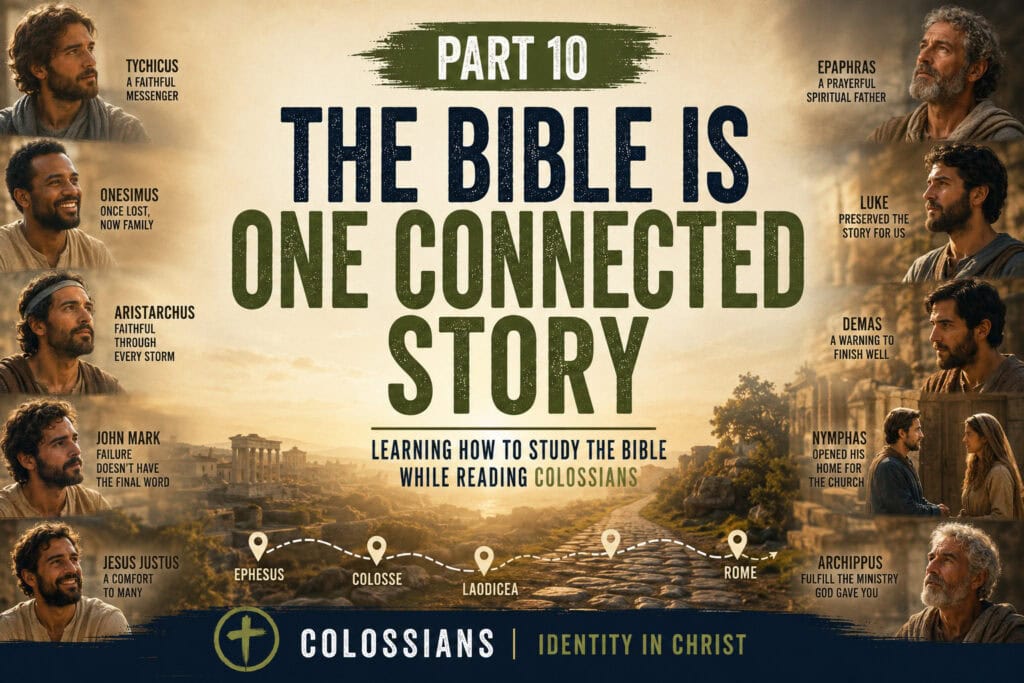
As we’ve walked through Colossians together, we’ve been doing more than studying one of Paul’s letters. We’ve been learning how to study the Bible. We’ve talked about context, asking good questions, seeing Christ throughout Scripture, following Paul’s flow of thought, recognizing types and shadows, reading through the lens of the New Covenant, and allowing God’s Word to shape the way we live.
As we come to the end of Colossians, I want to leave you with one final Bible study principle that has helped me tremendously over the years. The Bible is one connected story!
One of the biggest mistakes we make is reading the Bible in isolated pieces. We study one chapter, one verse, or one story without asking how it connects to the rest of Scripture. We especially do this when we get to the end of Paul’s letters. We see a list of names we don’t recognize and assume Paul is simply wrapping things up. But he’s not!
One of the best Bible study habits you can develop is asking, “Where else is this person mentioned?” When you start tracing people through the Bible, their stories begin coming together. You discover how God worked in their lives over time, and suddenly the Bible stops feeling like sixty-six disconnected books and starts reading like one incredible story of redemption.
The first person Paul mentions is Tychicus. If we only read Colossians, he’s just another name. But when we trace him through Acts 20, Ephesians 6, and 2 Timothy 4, we discover he was one of Paul’s most trusted co-workers. He carried letters to the churches, encouraged believers, and represented Paul when Paul couldn’t be there himself.
Paul never describes him as a famous preacher or a great apostle. He calls him a beloved brother, a faithful minister, and a fellow servant. I love that because not everyone is called to be the visionary. Some people are called to faithfully carry the vision. In the Kingdom, faithfulness is never second-class. God values dependability just as much as visibility.
Then Paul mentions Onesimus. If we follow his story over to the book of Philemon, we discover he was a runaway slave who met Paul, gave his life to Christ, and became one of Paul’s spiritual sons. Before Jesus, people knew him by his failures. After Jesus, Paul calls him a faithful and beloved brother.
That’s the Gospel! Jesus doesn’t just change where we’re going when we die. He changes who we are while we’re alive!
Next comes Aristarchus. His story stretches through Acts 19, Acts 20, Acts 27, and Philemon. Everywhere you find him, he’s standing beside Paul through riots, persecution, dangerous journeys, and prison. He stayed when ministry became difficult. That’s what faithfulness looks like. It’s easy to stay when everything is exciting. Loyalty is proven when things get hard!
Then we come to one of my favorite stories in the New Testament—John Mark. If we only read Colossians, we’d never know he once quit on Paul. But if we go back to Acts 13 and Acts 15, we discover Mark left the mission field early. Paul was so disappointed that he refused to take him on the next journey, and it caused Paul and Barnabas to separate.
Most people would have written Mark off. God didn’t. Years later Paul writes,
2 Timothy 4:11 “Get Mark and bring him with you, for he is useful to me for ministry.”
I love that because it reminds us that failure is never the final chapter when grace is writing the story.
Paul then mentions Jesus Justus. We don’t know much about him, but we know enough. Paul says he was a comfort to him. Imagine that being what you’re remembered for. You simply made people stronger because you were in their life. That’s ministry.
Next we come to Epaphras, and by now his name should sound familiar because we’ve talked about him throughout this series. When you connect Acts 19, Colossians, and Philemon, you begin seeing the whole picture. Epaphras was impacted during the revival in Ephesus, carried the Gospel back to Colossae, planted a church, and then faithfully prayed for those believers to mature in Christ. He didn’t just make converts. He made disciples. That’s how the Kingdom grows.
Paul then mentions Luke, the beloved physician. Most of us know Luke because he wrote the Gospel of Luke and the book of Acts, but don’t miss the fact that he faithfully stayed with Paul through some of the hardest seasons of his life. Luke reminds us that the Kingdom doesn’t just need preachers. It needs people who preserve what God is doing so future generations can learn from it.
Then there’s Demas.
At this point in the story, Demas is serving right alongside Paul. Everything appears to be going well. But when we keep following his story into 2 Timothy 4:10, Paul sadly writes,
“Demas has forsaken me, having loved this present world…”
That’s a sobering reminder that it’s not enough to start well. We want to finish well. The Christian life isn’t measured by one good season. It’s measured by faithfully walking with Jesus for a lifetime.
Paul also mentions Nymphas, who simply opened his home for the church to meet. Before church buildings, that’s how the church grew. Ordinary people opened ordinary homes and made room for God to work. Never underestimate hospitality. Sometimes a living room becomes the place where someone’s life is forever changed.
Paul then tells the Colossians to pass this letter on to the church at Laodicea and to read the letter coming from Laodicea. These letters circulated from church to church because God’s truth was never intended to stop with one group of people. Truth is meant to be passed on.
Finally, Paul gives Archippus one simple challenge:
Colossians 4:17 ”Take heed to the ministry which you have received in the Lord, that you may fulfill it.”
We don’t know if Archippus had become discouraged or if Paul was simply encouraging him to stay the course. Either way, the application is the same. It’s not enough to discover God’s calling.We have to finish it.
As I close this series, I think that’s one of the greatest lessons we can learn from the end of Colossians. Don’t skip over the names. Follow their stories. When you see someone mentioned in Scripture, ask, “Where else do I find them?” Then read those passages. Before long you’ll begin connecting the dots, and the Bible will start coming alive in a whole new way.
You’ll realize it isn’t a collection of disconnected stories. It’s one connected story centered on Jesus Christ. And here’s what I love most. Paul poured his life into people like Tychicus, Onesimus, John Mark, Epaphras, Luke, and countless others. They, in turn, poured their lives into others. That’s how the Gospel spread across the Roman Empire, and that’s still how God’s Kingdom advances today.
Transformed people transform people! That’s how the new creation continues!