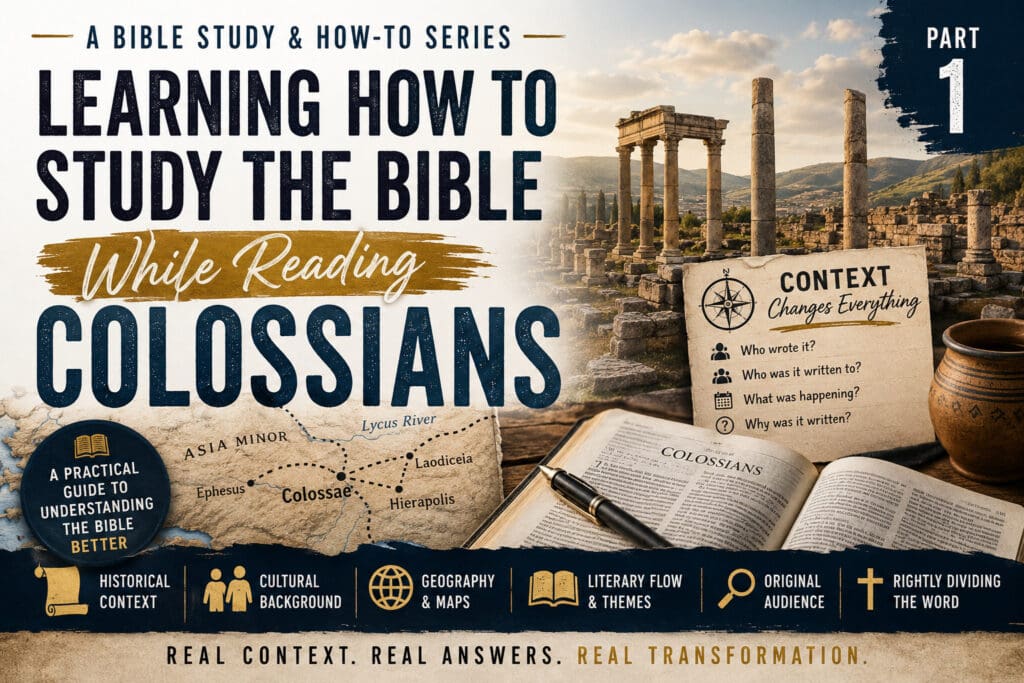
One of the best ways to learn how to study the Bible is to actually study the Bible in real time, and that’s what we’re going to do together as we walk through the book of Colossians. This series is not just going to teach through Colossians itself; it’s also going to teach practical Bible study principles, hermeneutics (how to properly interpret Scripture), and study techniques you can use in any book of the Bible.
A lot of Christians read the Bible devotionally, but never really learn how to study it. Because of that, people often pull verses out of context, miss the historical setting, ignore the flow of thought, or read modern American ideas back into the text. But when we begin learning how to ask the right questions, the Bible starts opening up on a completely different level.
As we go through Colossians together, we’re going to learn how to study:
- Historical context
- Cultural background
- Repeated themes and patterns
- Geography and maps
- Literary flow and thought progression
- Cross references throughout Scripture
- What the original audience would have understood
- How to properly interpret Scripture in context
The goal is not just information. The goal is learning how to rightly divide and accurately interpret the Word of God for yourself.
Bible Study Principle #1 —Start with Background, Context, and Cross-References
One of the first keys to understanding the Bible is learning the backstory before jumping straight into verses. A lot of confusion happens when people read one verse without understanding who wrote it, who they were talking to, what was happening in the culture, or why the letter was written in the first place.
The good news is you don’t have to go to Bible college to learn this stuff. Today there are tons of great tools available. Most study Bibles will give introductions to each book explaining the author, audience, historical setting, major themes, and purpose of the letter. Bible dictionaries, commentaries, maps, and even trusted online resources can help you learn the culture, geography, and background behind what you’re reading. Personally, I also recommend using cross references, reading introductions before the text itself, and looking at maps when studying a new book of the Bible.
The book of Colossians was written by the Apostle Paul around 60–62 A.D. while he was under house arrest in Rome near the end of the book of Acts. Paul didn’t personally plant the church at Colossae. Most scholars believe a man named Epaphras likely got saved during the revival in Ephesus in Acts 19, sat under Paul’s ministry for a season, and then returned home and planted the church at Colossae.
This is where one of the simplest Bible study techniques can really help you: start connecting different parts of the Bible together. For example, when we read Acts 19 about revival breaking out in Ephesus and then later read Colossians, we can realize how these events are connected. We start seeing how the Gospel spread, how churches were planted, and how disciples carried what they received into other cities.
Suddenly the Bible stops feeling like random disconnected stories and starts feeling like one big unfolding story of what God was doing through real people in real places. That’s one of the reasons context matters so much. We stop just reading isolated verses and start seeing the bigger picture of the Kingdom of God.
Bible Study Principle #2 — Use Maps and Geography
Another overlooked Bible study tool is simply using maps and geography. The Bible happened in real cities with real cultures, trade routes, political influences, and spiritual strongholds. Colossae was located in Asia Minor (modern-day Turkey) in the Lycus River Valley alongside cities like Laodicea and Hierapolis.
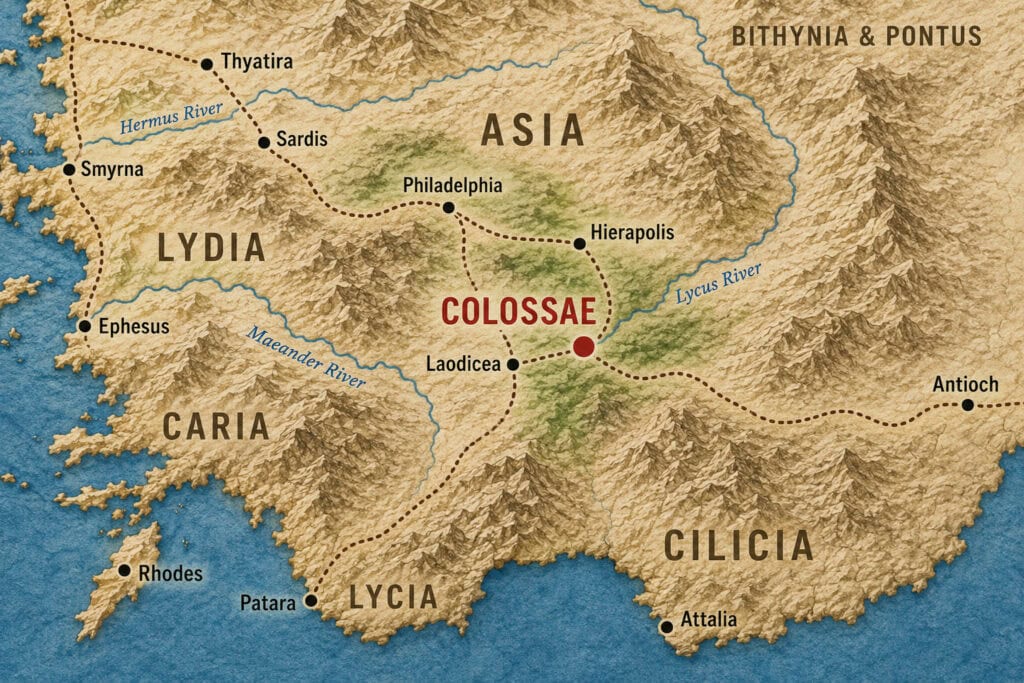
These maps reveals Colossae was a crossroads city where ideas, religions, philosophies, and spiritual beliefs were constantly flowing through the region. That becomes incredibly important because one of the biggest keys to Bible study is understanding the problem the writer was addressing. We can’t fully understand the letter until we understand what Paul was confronting.
Bible Study Principle #3 — Understand the Problem Being Addressed
Paul was dealing with syncretism — the mixing of Jesus with competing beliefs and influences. The false teachers weren’t completely rejecting Jesus. They were basically saying, “Jesus is good, but He’s not enough by Himself.”
That makes even more sense when we remember Colossae sat along major trade routes where ideas, religions, philosophies, and spiritual beliefs were constantly flowing through the city. Just like goods and commerce moved through Colossae, so did worldviews. The people in that church were being constantly exposed to outside influences competing with the truth of the Gospel. Does this make the maps come alive?
Honestly, the culture in 1st century Colossae sounds a lot like modern America. Through social media, entertainment, politics, podcasts, influencers, self-help culture, psychology detached from Scripture, New Age spirituality, and modern cultural values, people are constantly being discipled by competing voices.
When we want personal transformation, one of the best Bible study questions we can ask is:
“Where do we still see this today?”
That’s where Bible study stops becoming just information and starts becoming transformation.
Bible Study Principle #4 — Pay Attention to Repeated Themes
As we continue studying Scripture, another important principle is paying attention to repeated themes and ideas. One of the dominant themes in Colossians 1:1–18 is the supremacy and sufficiency of Jesus Christ. Paul keeps emphasizing that Jesus is enough, Jesus is above all, Jesus created all things, Jesus holds all things together, and Jesus has preeminence over everything.
Why does Paul keep repeating that Jesus is enough, Jesus is above all, and Jesus has preeminence over everything? Because the culture around them was constantly trying to add other things alongside Christ.
The Colossians were being influenced by Greek philosophy, Jewish legalism, mysticism, asceticism, folk superstition, angel worship, and early forms of gnosticism. People were saying things like:
- “Jesus is good, but you also need secret spiritual knowledge.”
- “Jesus is good, but you also need these religious rules.”
- “Jesus is good, but you also need mystical experiences.”
- “Jesus is good, but you also need other spiritual intermediaries.”
In other words, the culture kept adding to the simplicity and sufficiency of Christ. That’s why Paul keeps bringing everything back to Jesus. He’s showing them Christ is not one piece of the puzzle — He is the whole thing. Jesus is not just a good teacher, spiritual option, or part of a larger system. He is Creator, Sustainer, Lord, and Head over all things.
Once we start noticing repeated themes, we begin discovering the author’s main point instead of just collecting disconnected verses. One of the simplest but most powerful Bible study principles is this: repetition reveals emphasis. If the Holy Spirit keeps emphasizing something in a passage, we should probably pay attention to it.
Conclusion — Don’t Just Read the Bible, Learn to Study It
The Bible was never meant to be reduced to random verses on social media or quick devotional thoughts disconnected from context. Scripture was written through real people, to real churches, in real cities, dealing with real problems. When we slow down and study the backstory, geography, culture, themes, and flow of thought, the Bible begins opening up in a much deeper way.
As we continue through Colossians, don’t just look for information — learn to ask questions. Learn to look for patterns. Learn to connect passages together. Learn to see the bigger picture of what God was saying to the original audience and what the Holy Spirit is still saying today.
The more we study Scripture in context, the more we realize the Bible is incredibly relevant to the world we’re living in right now. The same pressures, competing voices, cultural confusion, and spiritual battles the early church faced are still happening today — and Jesus is still the answer.
Join me next week for Part 2 in this series.