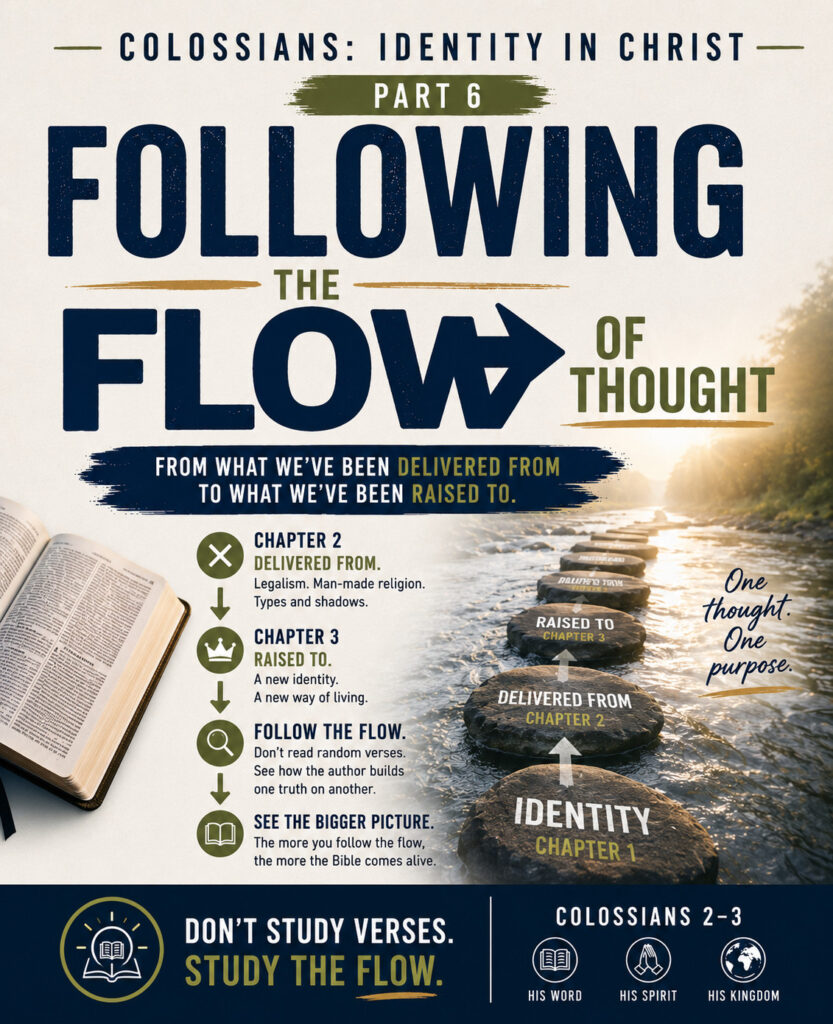
As we’ve been walking through Colossians together, we’ve been doing more than studying one book of the Bible. We’ve been learning how to study the Bible itself. We’ve talked about the importance of context, asking good questions, comparing Scripture with Scripture, seeing Christ throughout the Bible, finding the main point of a passage, and recognizing types and shadows. This week, I want to show you another Bible study principle that I think is often overlooked: learning to follow the flow of thought.
One of the easiest mistakes we can make when studying the Bible is reading it one verse at a time without paying attention to the author’s overall flow of thought. We read a verse, underline it, post it on social media, memorize it, and move on without ever asking how it connects to what came before it or after it. There’s nothing wrong with memorizing verses—we should. But if we only study isolated verses, we can easily miss the bigger point the author is making.
The biblical writers weren’t writing collections of inspirational quotes. They were writing letters, sermons, poems, and narratives. Every paragraph builds on the one before it. Every chapter moves the author’s argument forward. That’s why one of the best habits we can develop is learning to follow the flow of thought instead of reading disconnected verses.
That’s exactly what’s happening as we move from Colossians 2 into Colossians 3.
In chapter 2, Paul spent most of his time talking about what we’ve been delivered from. We’ve been delivered from legalism, religious performance, man-made rules, and the types and shadows of the Old Covenant because Christ is the substance. His concern was that the Colossians wouldn’t be pulled away from the simplicity and sufficiency of Jesus by empty religion or worldly thinking.
Without changing subjects, Paul begins chapter 3 by saying, “If you were raised with Christ…” (Colossians 3:1). A better way to understand that opening would be, “Since you have been raised with Christ…” Paul isn’t starting a new topic. He’s building on the one he just finished. He has shown us what we’ve been delivered from, and now he begins showing us what we’ve been raised to.
That’s how Paul writes throughout his letters. He always grounds our behavior in our identity. He doesn’t tell us to become someone we’re not; he reminds us of who we already are in Christ and then calls us to live accordingly.
Paul says we’ve already been raised with Christ. That’s past tense. Spiritually speaking, something has already happened to us. Of course, that raises another question. If we’ve already been raised with Christ, why don’t we always feel like it?
The answer is that the new birth happened in our spirit, not in our soul or our body. 1 Thessalonians 5:23 tells us we are spirit, soul, and body. Our spirit was made brand new the moment we trusted Christ. Our soul—our mind, emotions, and will—is still being renewed. You can learn more about spirit, soul, and body here. Much of the Christian life is simply learning to think in agreement with what God has already done in our spirit.
That’s why Paul immediately says in Colossians 3:2, “Set your mind on things above, not on things on the earth.”
I love that word set. We have to set our minds just like we set our alarm clock every night. Nobody accidentally renews their mind. Left on autopilot, our thoughts drift toward fear, worry, offense, comparison, and whatever culture is shouting at us that day. Renewing our minds is intentional. Every day we choose what we’re going to think about and what we’re going to believe.
Paul isn’t telling us to ignore the world around us or become so heavenly minded that we’re no earthly good. Actually, it’s just the opposite. God’s plan has never been escaping earth. His plan has always been bringing heaven to earth.
When you step back and look at the whole story of Scripture, you begin seeing that theme everywhere. Many theologians believe the Garden of Eden functioned as the first temple—a place where heaven and earth overlapped. God walked with Adam and Eve there and commissioned them to extend His rule throughout the earth. The tabernacle Moses built was patterned after a heavenly reality. Jesus taught us to pray, “Your kingdom come. Your will be done on earth as it is in heaven.”
Paul is saying the same thing. Live from heaven’s reality so you can bring heaven’s reality into the earth. That’s what it means to seek the things that are above.
Then Paul says something that’s fascinated me for years.
Colossians 3:3 says, “For you died, and your life is hidden with Christ in God.”
Our new life is hidden. Not hidden from us, but hidden for us. Proverbs 25:2 says, “It is the glory of God to conceal a matter: but the glory of kings to search out a matter.”
That’s why we stay in the Word. That’s why we pray. That’s why we pray in the Spirit. As we seek Him, the Holy Spirit continues revealing who we already are in Christ. Our identity isn’t something we create. It’s something we discover.
Once Paul establishes our identity, then he begins talking about how we live.He tells us to put off the old man and put on the new. I love that picture because every morning we intentionally choose what we’re going to wear. The clothes are already hanging in the closet. We simply put them on.
The same is true spiritually. Paul isn’t telling us to manufacture compassion, kindness, humility, meekness, patience, and love through self-effort. He’s saying those qualities already exist in our born-again spirit because Christ lives in us. We already own them. Every day we simply choose to put them on.
That’s why the order matters so much. We don’t pursue holiness so God will give us a new identity. We pursue holiness because we’ve already been given a new identity in which holiness is a part.
The Christian life isn’t about trying harder in the flesh. It’s about learning to live from a completely new reality. We’ve been raised with Christ. We’ve been seated with Him. Our old life is gone, and our new life is hidden in Him. As we renew our minds to that reality, we begin thinking differently, speaking differently, loving differently, and living differently.
That’s Paul’s whole argument. Chapter 2 tells us what we’ve been delivered from. Chapter 3 tells us what we’ve been raised to. When we follow Paul’s flow of thought instead of reading isolated verses, the message becomes beautifully clear. Christianity isn’t about self-improvement; it’s about living from the new identity Christ has already given us. As we learn to live from that reality, heaven begins showing up in the way we live every day.