As we’ve been walking through Colossians together, we’ve been learning more than just the content of this incredible letter. We’ve been learning practical Bible study principles that can help us understand the entire Bible. We’ve talked about studying the historical context, asking good questions, comparing Scripture with Scripture, seeing Jesus throughout the Bible, and finding the main point of a passage.
This week, I want to introduce another important Bible study principle: learning to recognize types and shadows.
One of the things that has made the Bible come alive for me over the years is realizing that the Old Testament wasn’t just recording history—it was pointing forward to Jesus. Much of what we read under the Old Covenant was a type, a picture, or a shadow of something much greater that would one day be fulfilled in Christ.
That’s exactly what Paul is teaching in Colossians 2:11-23.
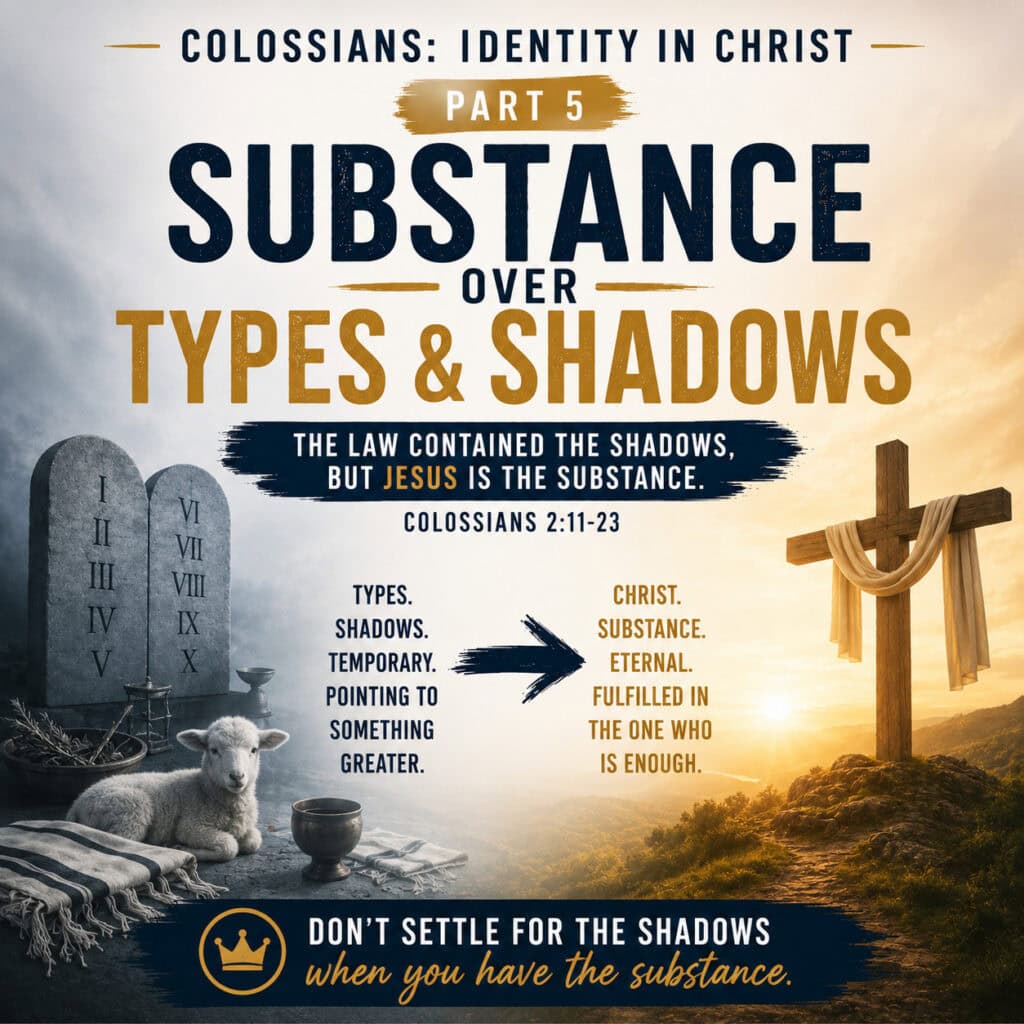
In Colossians 2:17, after talking about the Sabbath, festivals, food laws, and other parts of the Law, Paul says they “are a shadow of things to come; but the body is of Christ.” The word body carries the idea of the substance or the reality. In other words, the Law contained the types and shadows, but Jesus is the substance they were pointing toward.
I like to think of it this way. Imagine you’re standing outside waiting for someone you love to come home. Before you see them, you see their shadow coming around the corner. The shadow tells you they’re on the way, but once they arrive, you don’t run over and hug the shadow—you hug the person.
That’s Paul’s point. The Law was never the destination. It was preparing people to recognize Jesus when He came. Once we begin reading the Bible through that lens, the Old Testament opens up in a whole new way.
- The Passover lamb was a type of Christ, our Passover Lamb.
- The Sabbath was a shadow of the rest we now have in Christ.
- The sacrifices pointed to the one perfect sacrifice Jesus would offer once and for all.
- The scapegoat pictured Jesus carrying our sins away forever.
- Even the tabernacle, priesthood, feasts, and ceremonies were all pointing beyond themselves. They weren’t the substance—they were types and shadows of the One who was to come.
Paul illustrates this several different ways throughout this passage.
In Colossians 2:11, he says we’ve experienced a circumcision made without hands. Physical circumcision was an outward sign under the Old Covenant. It pointed forward to something much greater. Through Christ, God has performed a spiritual circumcision, cutting away our old sinful nature and making us new.
Then, in Colossians 2:12, Paul talks about baptism. Baptism isn’t just a religious ceremony; it’s a picture of our old life being buried and our new life being raised with Christ. It even reminds us of Israel passing through the Red Sea, leaving Egypt behind forever. Egypt became a type of our old life, and the crossing became a picture of our salvation.
Paul then makes one of the most powerful statements in the chapter. In Colossians 2:14, he says the handwriting of ordinances that was against us was nailed to the cross.
The Law exposed our sin. It showed us our need for a Savior. But once Christ fulfilled the Law, the debt was canceled. The accusation against us was removed because Jesus took it upon Himself.
Then Paul says something incredible in Colossians 2:15:
“And having spoiled principalities and powers, he made a shew of them openly, triumphing over them in it.”
I love that picture. Satan’s greatest weapon has always been accusation. But when Jesus went to the cross, He stripped the enemy of that weapon. The debt had been paid. The charges had been dismissed. Christ didn’t barely defeat the powers of darkness—He publicly triumphed over them.
That’s why Paul immediately warns the Colossians not to go backward. Don’t let anyone judge you by food laws. Don’t let anyone judge you by holy days or Sabbaths. Don’t get caught up in angel worship, mystical experiences, or harsh religious rules. Why?
Because once the substance has come, there’s no reason to keep clinging to the types and shadows. I think this is incredibly relevant today because we still have a tendency to chase shadows.
Sometimes the shadows are religious. We think if we pray enough, fast enough, read enough chapters, attend enough church services, or keep enough rules, then God will finally be pleased with us.
Other times the shadows are cultural. We chase success, influence, experiences, or the next spiritual trend, believing those things will satisfy us.
Paul says all of those things miss the point. The point is Christ.
One of the greatest Bible study habits we can develop is asking this question every time we read the Old Testament:
“How does this point me to Jesus?”
The more we ask that question, the more we’ll begin seeing Christ everywhere. The stories become richer. The symbols become clearer. The feasts, sacrifices, and ceremonies all begin pointing in the same direction.
Jesus is the substance. Everything else was simply preparing the way for Him.
As we continue studying Colossians, let’s not settle for the types and shadows when we’ve been invited to know the One they were pointing to all along. The goal of Bible study isn’t simply learning more facts about the Bible. It’s seeing Jesus more clearly. And the more clearly we see Him, the more everything else begins to make sense.